Türkiye has strengthened its commercial and diplomatic footing in the international climate economy this month, striking a formal cooperation agreement with London Climate Action Week (LCAW) just as the country prepares to host COP31. The move signals growing confidence among Turkish institutions that circular economy expertise, built up over nearly a decade of domestic policy, can now be exported into one of the world’s most influential climate business networks.
The agreement was signed on 17 August between The Zero Waste Foundation and LCAW, establishing an institutional partnership intended to strengthen knowledge exchange, joint initiatives and international dialogue on zero waste and the circular economy. For businesses and investors tracking the climate sector, the protocol effectively opens a direct channel between Türkiye’s national zero waste programme and a London-based ecosystem that draws participants from government, finance, academia and civil society alike.
The timing is notable. With Türkiye set to host COP31, the partnership gives the country an early platform to present its circular economy credentials to an international audience of policymakers and investors well before the summit itself convenes. LCAW’s network spans exactly the kind of cross-sector actors, financial institutions, city administrations and corporate players, that Türkiye will need to engage if its zero waste model is to translate into wider international cooperation or investment.
A commercial case built on a decade of policy
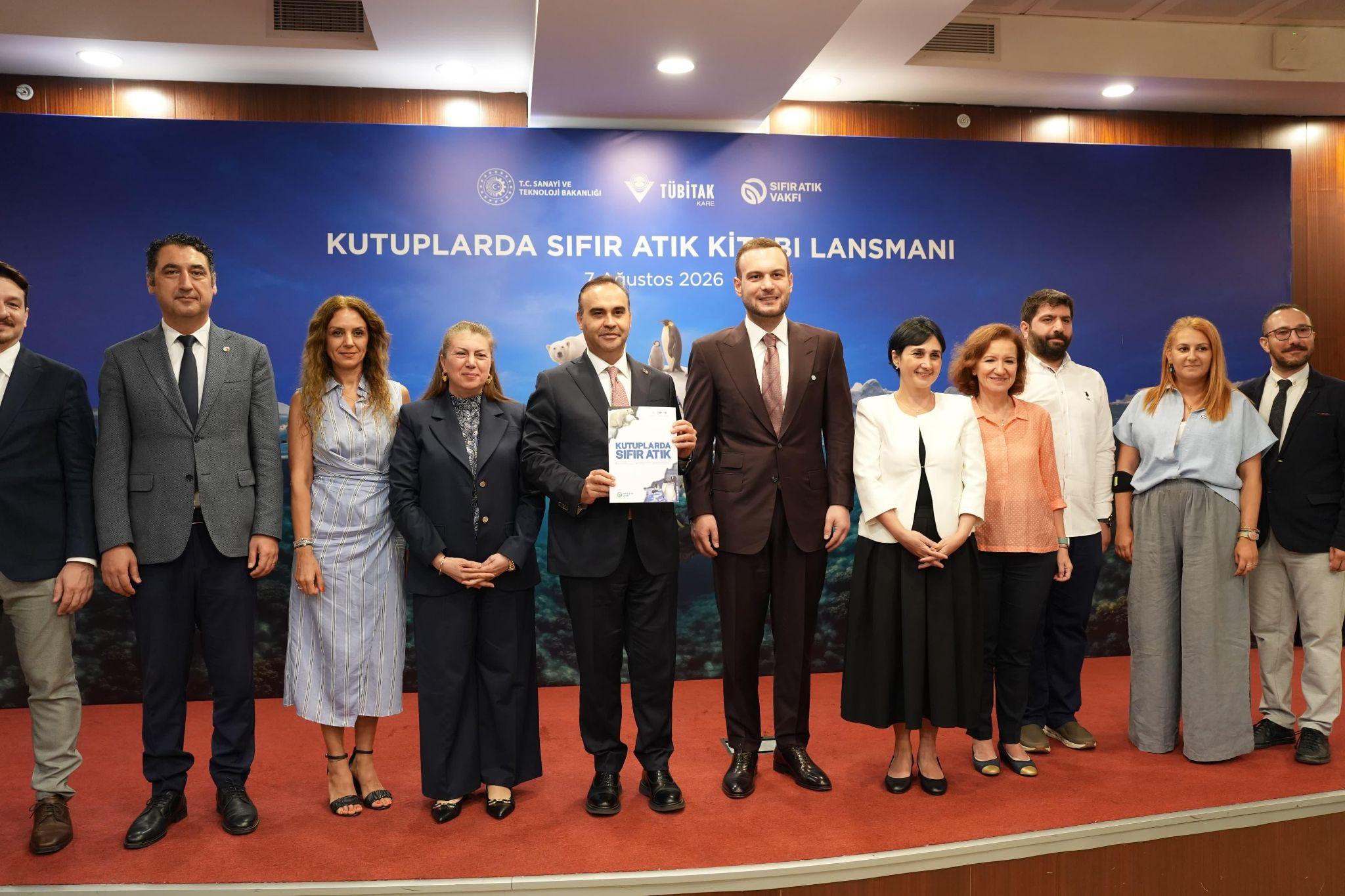
The London protocol did not emerge in isolation. Ten days earlier, on 7 August, the Foundation launched a book titled “Zero Waste in the Polar Regions”, produced jointly with the Polar Research Institute of TÜBİTAK, the Scientific and Technological Research Council of Türkiye. The publication applies zero waste and resource efficiency principles to scientific research conducted in the Arctic and Antarctic, an area where logistics, materials use and energy management carry significant cost implications for research operations.
Mehmet Fatih Kacır, Minister of Industry and Technology of Türkiye, framed the book as the convergence of two state-backed initiatives that both began in 2017. “The Zero Waste initiative launched under the leadership of H.E. Emine Erdoğan has grown step by step from a national initiative into a global one,” he said.
He added: “At the same time, we began organising scientific expeditions to Antarctica and the Arctic under the auspices of the President of the Republic of Türkiye, enabling Turkish scientists to strengthen the country’s presence in polar research. Through this book, these two initiatives have come together.”
From a business standpoint, the publication is less about polar science for its own sake and more about demonstrating a transferable methodology. It comprises 18 articles from scientists who have conducted polar fieldwork, addressing the scientific, technical, administrative and communication dimensions of applying zero waste principles in extreme, resource-constrained environments. The work looks at how expeditions are planned, how materials and resources are procured and used, and how energy, water and logistics are managed, treating waste reduction as a design principle rather than an afterthought. Those are operational disciplines with direct relevance to industries managing complex, resource-intensive supply chains far removed from polar research itself.
The book also positions the polar regions as indicators of broader global climate trends, arguing that environmental changes recorded there carry consequences well beyond the Arctic and Antarctic. That framing gives the research, and by extension the resource efficiency methods it documents, relevance to a much wider set of industries and markets than the geography alone would suggest.
Institutional signatures and next steps
The London protocol was signed by Samed Ağırbaş, President of the Zero Waste Foundation and COP31 High-Level Climate Champion, and Nick Henry, Climate Action Founder and CEO. The involvement of a COP31 High-Level Climate Champion in the signing underscores the extent to which Türkiye’s zero waste diplomacy is now being run in parallel with its formal COP31 preparations, rather than as a separate track.
“After this cooperation protocol, I hope we will carry out strong work and organize joint events at COP31 and London Climate Action Week,” Ağırbaş said.
For now, the practical output of the agreement is expected to centre on joint events and exchange between the Foundation and the LCAW network, with COP31 itself providing the wider diplomatic and economic backdrop rather than an immediate deliverable. That distinction matters for businesses assessing the pace of any resulting commercial opportunities: the protocol establishes a framework for cooperation, but concrete joint programming is still to be scheduled around the two climate events.
Why the partnership matters beyond waste management
Both developments this month draw on a wider zero waste vision associated with H.E. Emine Erdoğan, Founder of the Zero Waste Movement, Chair of the UN High-Level Advisory Board on Zero Waste and Honorary President of the Zero Waste Foundation. The initiative, launched in 2017, has expanded from a domestic Turkish programme into one with international reach, a trajectory that the LCAW agreement and the polar research book both extend further.
What distinguishes this latest push is its refusal to treat zero waste purely as a recycling or waste management exercise. The polar research book frames zero waste as a resource efficiency discipline applicable to scientific operations in extreme environments, while the LCAW agreement frames it as a circular economy proposition suitable for engagement with government, finance and business audiences in London. Together, the two developments link scientific research, resource efficiency and circular economy thinking into a single narrative ahead of COP31.
For UK and international businesses operating in climate-related sectors, the practical significance lies in the access route now established: a formal channel between Türkiye’s zero waste institutions and the LCAW network, active in the run-up to a COP summit Türkiye itself will host. Whether that channel yields specific commercial partnerships, joint ventures or investment flows remains to be seen, but the institutional groundwork, backed by a government minister, a COP31 climate champion and a UN advisory board chair, has now been formally laid.